Česká verze Czech President's Personal Pages


Homepage - Prague Castle - Guidepost for visitors - Old Royal Palace

Old Royal Palace

Vladislav Hall from the 3rd courtyard The Palace grew and gradually gained its present appearance from the time of its founding in the late 9th century. The original wooden building with a stone foundation wall was converted into a stone Romanesque palace by Prince Sobeslav in the early 12th century. Remainders of it have been preserved in the underground to the present. The palace was adjoined on its eastern side by All Saints' Chapel, which was consecrated in 1185.

In the first half of the 14th century the king and emperor Charles IV had a Gothic palace with a vaulted interior for state purposes and a band of arcades on its northern side built on the site of the Romanesque building. During the reign of his son Wenceslas IV two perpendicular wings were added and All Saints' Chapel was reconstructed.

The palace was deserted for entire eighty years of the stormy 15th century. After 1483 the king Vladislav Jagiello returned to Prague Castle and commenced the last large-scale reconstruction of the palace. The magnificent solemn Vladislav Hall was added to it and when designing it the architect Benedikt Ried combined the art of the Late Gothic with elements of the newly arriving Renaissance style. The perpendicular palace wing named after Vladislav's son Ludvik is also the work of B. Ried. After the succession of the Habsburgs to the Bohemian throne the interiors of the Old Royal Palace were used for coronation festivities and diets and as conference rooms, offices and depositories. New dwelling quarters were built to the west of the palace, in the southern part of the Castle complex. After the catastrophic fire which occurred in 1541 the Diet and All Saints' Church were rebuilt.

The Theresian Wing originated in the course of the reconstruction of the Castle in the 18th century. During the 20th century it has been subjected to several reconstructions. In 1993 it was adapted for an exhibition of creative art.

The Vladislav Hall

Old Diet From the 16th century the Vladislav Hall served particularly royal state purposes. It was the scene of coronation festivities and banquets, knights' tournaments and markets with artistic and luxurious goods. The Vladislav Hall still partly fulfils the state function: the elections of the president of the Czech Republic and ceremonial gatherings connected with important days in the life of this country take place in it.

Neighbouring on the Vladislav Hall is the Diet, which through the furnishings of its interior affords an idea of the way in which the proceedings of the Diet took place after 1627, and also All Saints' Church.From the south-western corner of the Vladislav Hall a portal leads to the Ludwig Wing with the offices of the Czech Chancellery. In 1618 its second room witnessed the beginning of the uprising to the Czech Estates when two governors and a scribe were thrown into the castle ditch from its window. The uprising of the Czech Estates was the first conflict of the Thirty Years' War (1618-1648).

The observation gallery on the southern wall of the Vladislav Hall affords a beautiful view of the Garden on the Ramparts and of Prague.

Nowadays the exit from the Vladislav Hall is formed by the Riders' Staircase, built originally to enable knights to enter the hall on horseback in order to take part in the jousting competitions held in it. The staircase is vaulted with a complicated Late Gothic rib vault.

All Saints' Church

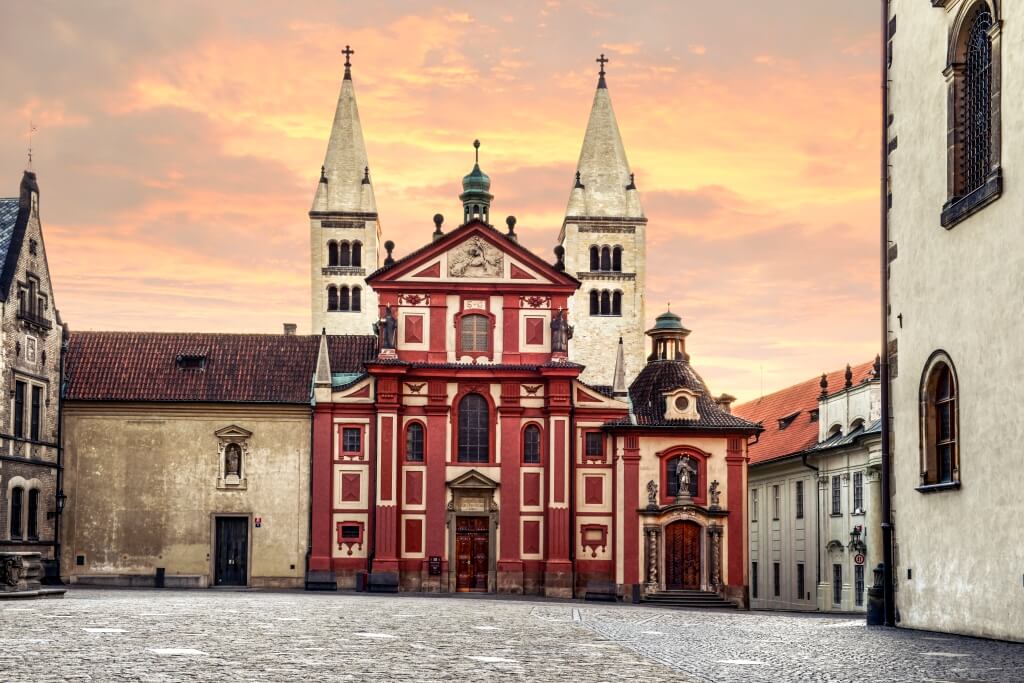
The All Saints' Church was built by Petr Parler on the site of the Romanesque palace chapel, also consecrated to All Saints. According to old sources the church was magnificently decorated in the manner of La Chapelle in Paris. However, after the great fire of 1541 only its peripheral walls remained.

In the course of its renewal the church was extended as far as the facade of the Vladislav Hall and during later modifications it was connected with it by means of a portal.

Situated in a recess on the northern side of All Saints' Church is the tomb of St. Procopius, whose life is portrayed in the cycle of paintings on the walls.

Old Royal Palace is part of sightseeing tour of the Prague Castle.
The Theresian Wing is adapted for an exhibition of creative art.
A view of the interior of All Saints's Church can be gained from the Vladislav Hall. The church is open to the public only when religious services (Saturday at 4 p.m.) and concerts take place in it.

print top


Welcome to the Prague castle

Cultural calendar 

September 2013

            1
2 3 4 5 6 7 8
9 10 11 12 13 14 15
16 17 18 19 20 21 22
23 24 25 26 27 28 29
30            

Prague Castle invites visitors to the Treasury of St. Vitus Cathedral exhibition

12/16/2011 - 12/16/2021

Prague Castle invites visitors to the Treasury of St. Vitus Cathedral exhibition - 12/16/2011 - 12/16/2021 The Chapel of the Holy Cross in Prague Castle’s Second Courtyard houses an extraordinary display of masterpieces amassed from the 11th century for the St. Vitus Church and Cathedral treasury.