
President Pavel's opening remarks at GLOBSEC Forum 2025
5/21/2026
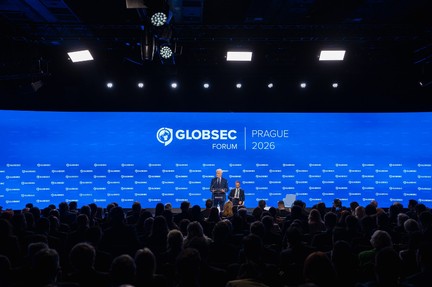
Distinguished leaders, Excellencies, ladies and gentlemen, dear guests,
It is a pleasure to welcome you once again for the GLOBSEC Forum. For more than two decades, GLOBSEC has been one of Europe’s most important platforms for strategic debate. It brings together political leaders, experts, business representatives and civil society at a time when we need open and frank conversations more than ever.
Last year, I spoke here about Europe’s political will, industrial capacity and technological sovereignty. I argued that Europe must continue to stand with Ukraine but also learn to stand more firmly on our own feet. Well, that message remains valid. If anything, it has become even more urgent
Russia’s aggression against Ukraine continues into its fifth year and conflict in the Middle East has once again demonstrated that the region can be a source of instability to the world. International relations are increasingly shaped by power rivalry, coercion and the use of force. And the transatlantic relationship, while still indispensable, is changing in nature.
Today, I would therefore like to focus on three closely connected themes:
- first - stronger European pillar within NATO,
- second - closer NATO-EU cooperation, and
- third - strategic importance of continuing our support for Ukraine.
Let me begin with the issue of European pillar of NATO. I guess by now we all agree that Europe must assume greater responsibility for our own defence. Not because we are told so by Washington, but because it is in our own strategic interest. The United States is increasingly focused on other strategic priorities, particularly in the Western Hemisphere and in the Indo-Pacific, while debates about the future scale of America’s conventional military presence in Europe are becoming more pronounced.
Europe must be prepared for this reality. This does not mean that Europe should turn away from the United States. Just the opposite! NATO remains the foundation of our collective defence. And the transatlantic bond remains essential for our own security. But we must be honest: many assumptions supporting the old security architecture are no longer valid.
The core task ahead of us now is to build up a politically, militarily, industrially and operationally stronger European pillar within NATO. This marks a fundamental rebalancing within the Alliance. A true burden-shifting, not just burden-sharing!
For decades, Europe’s role inside the Alliance was primarily defined by contribution. Today, it must increasingly also be defined by responsibility and readiness.
But a stronger European role should not mean creating separate structures alongside NATO. On the contrary - European defence efforts need to be fully integrated into NATO’s planning, capability targets, command structures and force development. This is the real meaning of a stronger European pillar: not an alternative to the Alliance, but a Europe that is a stronger presence within the Alliance.
Collectively, we have already made significant progress in defence spending, ammunition production or support for Ukraine. Yet, credible defence is not built on spending levels alone.
We need to work hard to strengthen our strategic enablers and close critical gaps in areas such as strategic air lift, air and missile defence, intelligence, logistics or military mobility. There is no time to lose! Because in the end, defence is not only about how many soldiers and weapons we have. It is more about what operations we can carry out; if we can move forces quickly, supply them and coordinate them when it matters most.
The second issue I wish to raise is NATO-EU cooperation. We have discussed this topic for decades, with relatively modest enhancement, I must admit. Clearly, NATO defines core military requirements for collective defence.
The European Union, on the other hand, has instruments that NATO does not have: funding, infrastructure and industrial policies, single market and other policy tools. I am convinced these two sets of instruments should be connected.
NATO and the European Union are not competitors in European security. They should function as complementary pillars. Military mobility is the clearest example. NATO knows very well which routes, ports, railways, bridges and airfields are critical for moving forces across Europe in a crisis. EU has the financial and regulatory tools to help modernise much of that infrastructure.
The task is to make sure that the two plans overlap: that NATO’s military requirements guide EU investment, and that EU investment strengthens NATO’s deterrence. This could also include partners beyond the EU. The United Kingdom, Canada and Norway are indispensable European security actors. Their role in logistics, maritime security or intelligence, as well as in support of Ukraine, is invaluable. And conversely: we need to articulate the role within the EU for member states which are not part of NATO.
My third observation is particularly relevant for us here, in Czechia and in Central Europe.
Our region, through its history and geography, understands well that security and deterrence are not abstract ideas. And I am glad that the Czech Government has recognized the challenges we are facing. I fully support the Government’s efforts to allocate additional resources to fulfil at least the 2% target for this year.
Our historical experience with Russia also shapes our conviction that the fate of Ukraine is central to European security.
Two weeks ago in Prague, we agreed with President Alexander Stubb that “Europe needs Ukraine more than Ukraine needs us”. I am convinced that Ukraine is not only defending Europe. It is transforming Europe - its defence industry, military thinking and strategic culture.
Ukraine has become one of Europe’s most capable defence actors. It has demonstrated remarkable resilience, gained extensive combat experience, and developed technological innovation.
Ukraine is changing the way Europe thinks about warfare itself - from drones and electronic warfare to industrial production and battlefield innovation.
Supporting Ukraine is not charity. This is a direct investment in Europe’s own security. Because if Ukraine succeeds, Europe is safer. If Ukraine is forced into a bad peace, we all will live with the consequences for decades.
My conclusion is obvious here: We must continue supporting Ukraine’s defence against Russian aggression!
Ladies and gentlemen,
Peace in Europe can no longer be treated as the default state of affairs. It must once again be actively protected, defended and maintained.
The lesson of this moment is not that Europe is alone. It is that Europe needs to be strong enough to stand on its own when needed.
All allies need to work together towards a strong Europe that strengthens NATO, that invests in weapons, resilience and innovation and that boosts its industrial capacity.
The coming years will decide whether Europe becomes a strategic actor. I am convinced that it can. Europe does have economic strength, industrial potential and democratic resilience.
In today’s geopolitical environment, speed has become a strategic capability. History will simply not wait for Europe to become ready.
We must act swiftly!
Thank you for your attention.
President of the Czech Republic, Petr Pavel, GLOBSEC Forum, 21st May 2026